

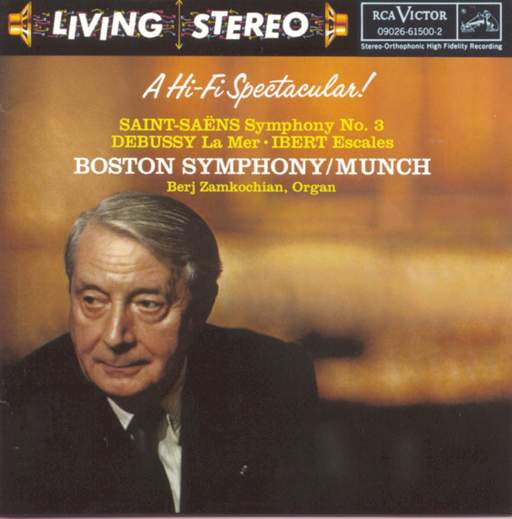
This is one of the great Living Stereo recordings, and the edition question here is less about finding something listenable than about deciding how close you want to get to the original tapes. None of the three editions fail the music. They do not all serve it equally.
Saint-Saëns completed his Third Symphony in 1886, at what he considered the peak of his powers, and dedicated it to the memory of Franz Liszt, who had died that summer. The shadow of that dedication is audible in the music: the opening theme is said to draw paralels with Dies irae, and there is something valedictory in the way the work moves from darkness toward the luminous major-key organ entry of the finale.
It was his last symphony. The 1959 recording by Charles Munch and the Boston Symphony Orchestra, made at Symphony Hall Boston over two April sessions and captured on three-track analog tape by engineer Lewis Layton, remains the benchmark.
Munch conducts with the authority of someone completely at home in this repertoire, and organist Berj Zamkochian's contribution to the finale is exactly what the music asks for.
What to listen for
- Room ambience
- Strings, placement, spacing, transients
- Organ tone
- Soundstage
Unlock the Full Comparison
This comparison of 3 digital editions of Saint-Saens: Symphony No.3 'Organ' is available exclusively to TrueResAudio members. Sign up or log in to get access to full reviews, edition comparisons, rare finds and overlooked discoveries, and curated deals.
Subscribe