

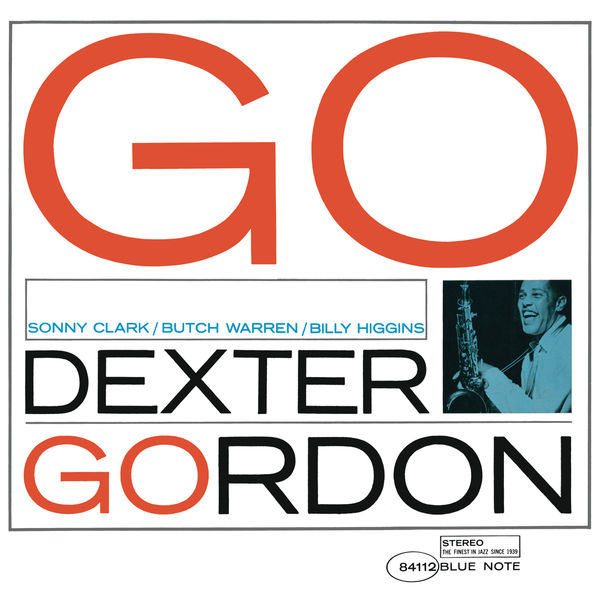
Dexter Gordon

Go!

Jazz
Go! cover
Released:
1962
Original label:
Blue Note
Editions Covered
4
Last updated:
1 Jul 2026

Go! is one of the greatest hard bop albums ever made, and Gordon's own favourite recording. Luckily, with one notable exception, most digital editions do it justice.

What to listen for

  • Cymbal ping
  • Bass presence
  • Room ambience
  • Sonic artifact in the right channel

To call Dexter Gordon's Go! a masterpiece would be an understatement.

It's not only one of his best albums, but probably one of the best hard bop albums of all time. Gordon reportedly considered Go! his favourite of his own recordings. And in 2019 the Library of Congress selected Go! for the National Recording Registry as culturally, historically, or aesthetically significant.

Interestingly, The Go! sessions was the very first date all four musicians had played together. Clark, Warren and Higgins had worked together earlier in 1962 backing Jackie McLean and Don Wilkerson, but they hadn't played with Gordon before.

But you don't hear that. They sound as if they had time to gel together. It just shows you what a calibre of musicians they were.

Go! has been reissued and remastered several times since the original release. In 1985, Blue Note reissued it on a CD for the first time. I couldn't find any specific information about the source, however, I suspect it was still the analog transfer with little mastering done back then.

In 1999 Rudy Van Gelder remastered the album. I've featured my impressions of that edition below.

Analogue Productions issued a SACD version in 2010. Kevin Gray remastered it again for vinyl in 2019, however, neither of those editions are available in digital format.

Important: There is an interesting sonic artifact in "Cheese Cake" that's worth paying attention to. It appears in the right channel, roughly in the same corner of the studio where Billy Higgins' drums are, and you can hear it only when Gordon is playing. I can't fully figure out what that sound is. My guess is that it is either Billy Higgins humming to Gordon's playing, or the sound of Gordon's sax was bouncing of an object in that spot in the studio (one of the drum cymbals, perhaps?) The artifact is quite pronounced, although it does not affect the listening experience.

Some editions - RVG, for example, - clearly tried to bury it, however, as usually with such artifacts, the cost of removing them is often greater than the win. You lose too many frequencies in the process, and need to cover that up with compression.

Editions

Recommended
HDTT cover
Label:
HDTT
Year:
Format:
DSD256
Source:
Analog tape transfer
Preview:
Listening Notes

This is a transfer of an analog tape and it shows. The sound is pleasantly warm, highs are nice and gently subdued. They don't have any of that digital glare you find on other editions. All instruments have a nice and natural tone. Nothing seems pushed or subdued. The room is clearly audible. In fact, this is the only edition of Go! where the acoustics of the recording studio are so well preserved. The artifact I mentioned in the introduction is clearly audible. I actually discovered it on this edition. It does not reduce the listening experience, by the way, and provides a nice insight into this session.

Verdict

To me, an absolute winner when it comes to the listening experience. If you want to immerse yourself in this session and hear this music in a warm, pleasant sound with instruments sounding naturally, the recording studio's acoustics unravelling around you, and hear this music almost as if you were there, this is the edition to put on.

Blue Note cover
Label:
Blue Note
Year:
2013
Format:
24/192 FLAC
Source:
unknown
Preview:

This is the hi-res edition of the 2013 remaster.

Listening Notes

This edition has a slightly brighter tone. Highs have been clearly pushed up, not to the same "hot" levels as what Blue Note did with other Gordon's remasters, but they are clearly forward. Because of that, Gordon's sax seems louder than on HDTT edition. The dynamics is lower, also evident when you compare sound waves between editions. This edition also sounds more "aggressive", most likely due to the compression. The same adjustments caused the right channel artifact to be even more audible (although, still not to the point to be able to discern what the sound actually is.) The room acoustics have been reduced as well, the sound does not open up as much as on the HDTT edition.

Verdict

Not a bad edition overall however, the brighter sound and compression take away from the overall listening experience. You can hear that the sound is more contracted, and a lack of room acoustic is noticeable, too.

Blue Note cover
Label:
Blue Note
Year:
2013
Format:
16/44.1 FLAC
Source:
unknown
Preview:

This is the standard lossless edition of the 2013 remaster.

Listening Notes

Interestingly, this lossless edition of the 2013 remaster sounds slightly warmer than its hi-res counterpart. Highs don't sound so "hot" anymore. Unfortunately, it seems even more compressed, and there is hardly any dynamics audible. In the opening track, when Sonny Clark begins his solo, the music doesn't even get tiny bit quieter. Compare that with HDTT, where you clearly hear the drop in dynamics, or the hi-res edition of this remaster, and you'll quickly hear it. The room acoustics are basically inaudible. What you hear is just a compressed wall of sound. Interestingly, though, the artifact seems to have been buried in mastering, and at times, even completely disappears.

Verdict

Tone-wise, a slightly better sounding edition than the hi-res version of this remaster. However, the much stronger compression makes this record a far less enjoyable listen.

Blue Note cover
Label:
Blue Note
Year:
1999
Format:
16/44.1 FLAC
Source:
unknown
Preview:

This is the 1999 Rudy Van Gelder remaster.

Listening Notes

This is by far the worst sounding edition of Go! It's the loudness wars at its "best", with volume pushed up to the max, zero dynamics, and sound that puts highs above everything else. Room acoustics is non existent, dynamics is gone, and instruments don't sound natural at all. The edition also has a narrower mix, with a much smaller soundstage than any other edition I've evaluated here.

Verdict

An edition to avoid. There really is nothing good that I could say about it. Worth checking only to experience how mastering can ruin a perfect recording.

Closing notes

Cliche as it may sound, it's true: Go! is an album that requires good sound to fully open up. Rudy Van Gelder's 1999 remaster, focusing on pushing the volume as high as possible, reducing the soundstage, and eliminating any dynamics, illustrates this pretty well.

This edition is basically unlistenable.

But put on HDTT's analog tape transfer, or the 2013 remaster in hi-res, and you'll quickly get drawn into this music.

With HDTT, you also get a benefit of very audible room acoustics, making this edition sound the most natural to what the music must have sounded in the studio. But even the 2013 remaster, particularly the hi-res version, delivers solid listening experience.

Recording info

Recorded
August 27, 1962 at Van Gelder Studio, Englewood Cliffs, New Jersey
Recording engineer
Rudy Van Gelder
Producer
Alfred Lion
Mastering
Original label
Blue Note

Personnel

Tenor Saxophone

Dexter Gordon

Piano

Sonny Clark

Bass

Butch Warren

Drums

Billy Higgins

Program

  1. Cheese Cake
  2. I Guess I'll Hang My Tears Out to Dry
  3. Second Balcony Jump
  4. Love for Sale
  5. Where Are You?
  6. Three O'Clock in the Morning