

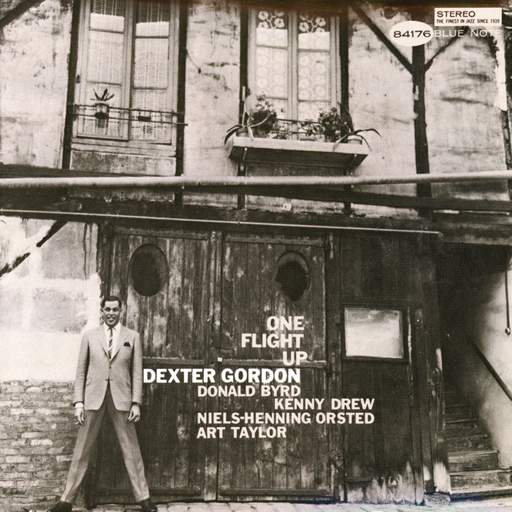
Dexter Gordon

One Flight Up

Jazz
One Flight Up cover
Released:
1965
Original label:
Blue Note
Editions Covered
3

One Flight Up is one of the great Blue Note sessions, and I think its official editions have largely failed it. The field here divides sharply: one transfer lets the recording breathe as it was captured, the others interfere with it in ways that cost more than they fix.

What to listen for

Recorded over just one session in Paris in June 1964, One Flight Up is the last album Dexter Gordon made for Blue Note, and one of the most spacious things in his catalogue.

Three tracks, two of them running well past the quarter-hour mark, built on modal vamps that open up rather than resolve.

Gordon had been living in Europe for two years by then, and the rhythm section around him reflects that geography: Kenny Drew and Art Taylor were both based on the continent, and an eighteen-year-old Niels-Henning Ørsted Pedersen, already the house bassist at Jazzhus Montmartre in Copenhagen, brought to Paris specifically for this date.

And the music they've created that one day, well, you can hear the ease of a group that has found its footing. Gordon plays with the unhurried authority that defines his best work, and the room at CBS Studios Paris is as much a presence as anyone on the bandstand.

Editions

Recommended
High Definition Tape Transfers cover
Label:
High Definition Tape Transfers
Year:
2022
Format:
Up to DSD256
Source:
Analog tape
Preview:
Listening Notes

There is a microphone placement issue in this recording. You can hear it in the bass and kick drum when either player hits harder than the room expects, a brief distortion that resolves quickly in the bass once Pedersen appears to have adjusted, but remains in the kick drum whenever Drew strikes it with particular force. On this edition, that artifact is audible. It is also, paradoxically, one of the reasons this edition works as well as it does. The tone here is warm and natural without tipping into softness. The room opens up around the instruments, and on headphones the detail is remarkable: saxophone notes catching the surface of Drew's cymbals, the bass carrying real grit and strong transients, the cymbal ping sitting forward in the mix with presence rather than brightness. There is some compression, but it sits lightly and does not close down the dynamics. A tape artifact appears in Tanya at around 4:21. I don't treat it as a distraction, though but adds authenticity to that edition.

Verdict

The edition to have. The analog warmth, natural dynamics, and the honest capture of the room make this the one I reach for. The recording's imperfections are part of what makes it feel alive.

Blue Note cover
Label:
Blue Note
Year:
Format:
16/44 FLAC
Source:

This edition includes a bonus track from the same session 'Kong Neptune'

Listening Notes

From the first notes, you can hear that something has gone wrong. The volume is pushed up, the brightness increased, and what is left is a loud, compressed edition that drains the life out of a recording that has plenty of it. The room echo is still technically present, but it has no direction or depth. Nothing bounces off anything. It is just there.

Verdict

Avoid. The mastering does this recording no favours, and there is no good reason to choose this edition when better ones exist.

Blue Note cover
Label:
Blue Note
Year:
Format:
24/192 FLAC
Source:

Features only the main program

Listening Notes

Compared to Blue Note's lossless edition, you immediately notice that this release is far quieter. But it does not seem as an attempt to push the dynamics but to resolve that microphone placement artifact, especially from the beginning of 'Tanya' (You can even see that when comparing the sound wave between this and HDTT edition.) That effort partly worked. The distortion at the start of the track is gone. But with it went the room, the natural sound, and much of the detail. And the kick drum artifact still appears when Drew hits hard anyway. What remains is a clean, safe edition but it also sound as if trying to keep distance from the recording it was meant to serve.

Verdict

Not my first choice but not a bad edition either. The mastering pulls back more than it needed to, and the atmosphere the HDTT edition captures so well is largely absent here. If the recording's rawness is not what you are after, this edition will do the job. Otherwise, go straight to HDTT.

Closing notes

What the editions of One Flight Up reveal, taken together, is a recording that divides mastering philosophies more sharply than most.

The Blue Note lossless is a straightforward casualty of volume and compression, and there is little more to say about it.

The more interesting division is between the 24/192 and the HDTT transfer. Both are working with the same source material and the same inherent imperfection, but they make opposite decisions about what to do with it. The Blue Note pulls back, smooths the edges, and produces something safe. The HDTT leans into the tape, lets the room exist as it was captured, and in doing so turns a recording artifact into evidence of a live session.

That is the edition that earns its place.

One Flight Up is a record that requires space and sonic detail, and the HDTT is the only edition that honours both.

Recording info

Recorded
June 2, 1964 CBS Studios, Paris
Recording engineer
Jacques Lubin
Producer
Francis Wolff
Mastering
Original label
Blue Note

Personnel

Tenor Saxophone

Dexter Gordon

Bass

Niels-Henning Ørsted Pedersen

Drums

Art Taylor

Piano

Kenny Drew

Trumpet

Donald Byrd

Program

  1. Tanya
  2. Coppin' the Heaven
  3. Darn That Dream