

Bacewicz String Quartet
Paul Kletzki: Complete String Quartets
Classical
Published: 4 June 2026
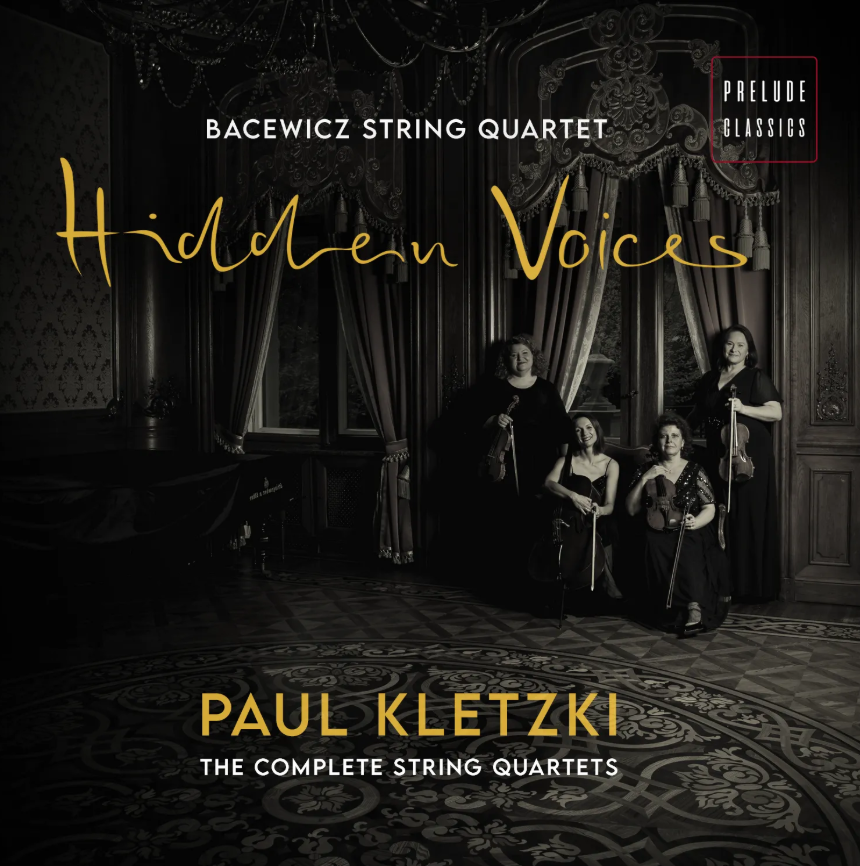
Paul Kletzki spent most of his life being known for other people's music.
He led the Berlin Philharmonic, the Philharmonia in London, the Israel Philharmonic, the Orchestre de la Suisse Romande, and a string of other major orchestras, becoming one of the leading conductors of the 20th century.
His compositions, however, share a story almost too neat for fiction.
During WWII, Kletzki had hidden the scores in the basement of the Hotel Metropole in Milan. And as it usually happens in those stories, these pieces were thought to be lost until someone discovered a chest with them inside during excavations in Milan in 1965
But, again, as it often happens, the story doesn't end here. Kletzki, fearing his scores had turned to dust, never opened the chest. It was only upon his death in 1973, his wife Yvonne opened it and found everything well-preserved.
Few facts about this album
- This release from Prelude Classics offers something genuinely rare: The first complete recording of all four string quartets, two of them world premiere recordings.
Music
These are not easy quartets. I want to be clear about that before anything else, because going in with the wrong expectations may blunt your experience.
The First Quartet, in A minor, interestingly, also Kletzki's Op. 1, roots itself deep in 19th-century structural thinking.
When preparing the background for this review, I read another reviewer revealing hearing an unmistakable hint of Tchaikovsky's Pathétique in the Largo's closing pages, and perhaps there is something in that. Certainly, there's that emotional weight and the way the movement refuses to resolve easily.
The Second Quartet in C minor, Op. 13 from 1925 is harmonically bolder and more transparent in its scoring. The first movement opens with a stark, lonely melody over pizzicato cello, reminiscent at moments of Shostakovich. The Finale turns more athletic.
The Third Quartet in D minor, Op. 23 from 1931 is more modern in character, almost impressionistic in harmonic freedom, while remaining lyrical and restless. There is contrapuntal writing that at times approaches fugal territory, and the second movement played con sordino over pizzicato cello, includes an unexpected slow waltz episode that is genuinely arresting.
The Fourth Quartet from 1942 is a different matter entirely. Its three movements carry no tempo or style markings. The first abandons late-Romantic idiom almost completely. The second moves closer to a Bartók-like soundworld with stronger emotional expressiveness. The third becomes livelier, with pizzicato and spiccato, before returning to unresolved chromaticism.
This quartet was apparently left in manuscript form intentionally by Kletzki himself; the Bacewicz Quartet prepared a new edition from the original manuscript and gave its first performance in 2023.
Sound
What strikes me immediately on this recording is how close the players are. Not close in a controlled, flattering studio sense, but in a sense of making me feel like sitting in the front row of a small hall: you hear the instruments before the room does anything with them.
For this music, and particularly given how demanding the scores are, that intimacy has a real effect. The players are right in front of you, and the complexity of the writing becomes something you track actively rather than observe from a safe distance.
At the same time, I also wished to be two rows further away. The front-row perspective is extraordinary for detail, but it does not allow you to step back and feel the room around you.
The mix is very dense. It places the four players very close together with little separation between them. However, transients are fast and land cleanly making following each voice effortless.
But that close mix also highlights ensemble coherence. The Bacewicz String Quartet plays almost as a single instrument here: four players in what sounds like a state of deep alignment, the lines interlocking rather than competing.
The dynamics are genuinely explosive at peaks. The tone runs slightly bright, which suits the nature of a string quartet, though I use a tube preamp in my chain and suspect the brightness would be even more pronounced without it.
Artifacts are essentially a non-issue: an occasional breath surfaces on headphone listening, but it is too subtle to register on speakers, and for music this complex and demanding, a recording this clean is exactly what the material requires.
My one honest reservation is the hall. The room is barely present. I know this was recorded in an actual concert space, but there is very little ambient decay to confirm it. On speakers, the close perspective becomes the entire acoustic picture. On headphones, particularly with my analytical cans, there is a slight natural distance that helps; with less analytical headphones, however, the close-up character returns fully.
I would have preferred a touch more air between the performers and my listening position, something that allowed the music to breathe and settle in space.
But don't get me wrong; the absence of that quality does not damage the listening experience seriously. However, it is there, as a mild limitation.
Final Take
Kletzki's string quartets are substantial, uncompromising, and long overdue for proper documentation. The Bacewicz Quartet plays them with clarity and structural conviction, and the this recording delivers an intimate, detailed, and dynamically alive presentation that serves the music well.
The slight recessing of the hall might be a small caveat if you prefer more spatial immersion. But this is a world premiere integral of four works that were assumed lost for decades and are now finally available in a serious hi-res recording. For anyone willing to give this music the full attention it asks for, the reward is considerable.
Listening Chain
The equipment used to evaluate this release for review.