

06 September 2026 • Featured Album • Classical
The haunting darkness of Daniel Bjarnason's Concertos
Bjarnasson's concertos are like nothing I've ever heard before. And it's not that he's breaking the rules of writing such a form. No. He absolutely does not. But he uses the form, and particularly the solo instrument, quite differently to what you might be used to.
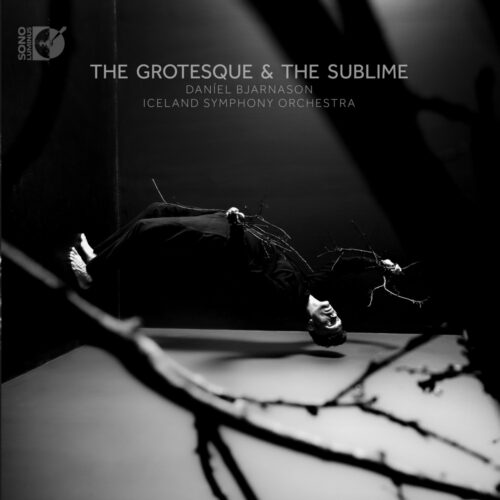
"Concerto" can be such an ugly word, can't it?
After all, how often does the form simply mean a soloist bending and twisting their instrument beyond the limits of the human body while the orchestra tries to do something meaningful in the background?
Now, don't get me wrong, I love classical music. I admire countless concertos (Rachmaninoff's 2nd Piano is my favourite.) But the fact remains that the form often puts virtuosity first and music second.
That's one reason I approached this recording of Daniel Bjarnason's piano and percussion concertos with caution.
And then, made it the featured album...
Bjarnasson's concertos are like nothing I've ever heard before. And it's not that he's breaking the rules of writing such a form. No. He absolutely does not. This is not Xenakis' Synaphaï, or Cage's Piano Concerto. This is not madness for madness' sake.
Bjarnasson's music is still, well, musical. But he uses the form, and particularly the solo instrument, quite differently to what you might be used to.
Take the piano concerto, FEAST. Piano is often used just to create an eerie atmosphere, rather than shine. For a piano concerto, the music is surprisingly illustrative. It sounds more like a ballet than a showcase of the instrument's capabilities.
INFERNO, the percussion concerto, expands the usual set of instruments with txalaparta (a traditional Basque instrument of wooden planks with no fundamental pitch but a rich overtone spectrum), drum kit, wood blocks, Japanese taiko drums, kick drum, and timpani.
Many of these instruments don't have a specific pitch. But they can create an atmosphere, and that's precisely what you hear here.
In fact, the entire release, which divides the two concertos with a short orchestra piece, FRAGILE HOPE, is nothing but dark and broody. Halfway through FEAST, the first concerto on the album, I realized that I was no longer approaching it as a concerto. Instead I found myself completely absorbed by the atmosphere, the pictures the music is painting, the story...
That last element is important here.
Bjarnasson's music does not come out of the sheer desire to write a particular form. It seems that, for him, music has a meaning, and his works are usually a result of some deeper internal processing.
FEAST, was composed during the Pandemic and inspired by the tradition of the Dance of Death (memento mori) as well as Edgar Allan Poe's 1842 short story The Masque of the Red Death. Bjarnason calls it "a solemn reminder of death's inescapable embrace" and "a monument to life's fleeting beauty."
The title of the first percussion concerto refers to the first part of Dante's The Divine Comedy, itself not a light read.
Even FRAGILE HOPE, although written simply as a tribute to composer Jóhann Jóhannsson rather than based on literary works, serves as, as the composer put it, "a reflection on the beauty Jóhannsson brought to the world, through both light and shadow."
Again, it shows.
However, there is one other thing worth noting. Bjarnasson is an Icelandic composer. I deliberately didn't mention that fact earlier, because, I didn't want you to approach this review with the notion that he's like many of his Icelandic peers - Ólafur Arnalds, Hildur Guðnadóttir.
Bjarnasson's music has little in common with their ambient/drone/spectral approach. You won't find long quiet textures in his music. His compositions don't move slowly and shift almost imperceptibly. No. He seems to include something we, listeners, can actually hold on to: a clear motif, a structure, a story.
His music has sharper edges. It changes often. I actually made a quick note while listening to FRAGILE HOPE, right after the lyrical theme entered about 2/3 into the piece that I am afraid of where the music is going to take me next.
It's not a feeling I get often when listening to concertos.
Perhaps that's why this album captivated me so much. It contains not only wonderful music. It does something not many modern compositions do. It held me tight from start to finish.
When the music ended, I found myself unable to move, still processing what has happened in my listening room.
And I couldn't press play again. Not right away. This music is so powerful that you really need to give yourself time to process it, to let it sound out inside you...
about me

Hi, I'm Pawel Grabowski. I'm a music writer and the person behind TrueResAudio
I write about albums, explore musical rabbit holes, and share the joy of discovering music one record at a time.
more essays