

The album that changed jazz, and still sounds like it. Some of its digital editions, however, fail to do it justice.
Kind of Blue arrived in 1959 and changed the direction of jazz in a single session. Miles Davis brought together Bill Evans, John Coltrane, Cannonball Adderley, Paul Chambers, and Jimmy Cobb, and gave them modal sketches instead of chord changes. The result was something none of them had fully played before. That looseness is audible. The music moves with a patience that hard bop rarely allowed. Each instrument finds its own space and stays there. Fifty years on, it remains the best-selling jazz album ever recorded, and it still sounds like nothing needed adding.
What to listen for
- Analog tape warmth
- Gentle room reverb
- Hall depth
- Instrument detail
Editions
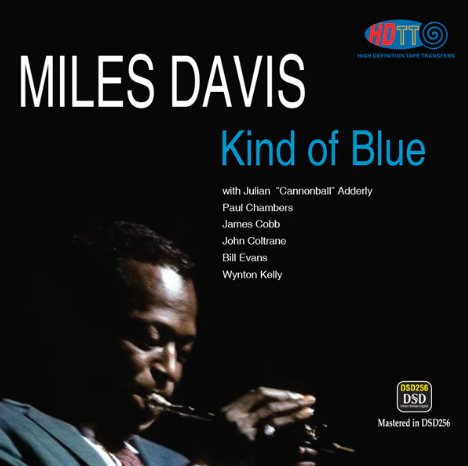
- Label:
- High Definition Tape Transfers
- Year:
- ?
- Format:
- Up to DSD256
- Source:
- 15ips 2-track tape
This edition is a direct transfer from an analog tape, and comes with both the original album and the original side 1 (first three tracks) speed corrected.
Without a doubt the most natural and analog sounding digital edition. I can't hear any compression, and the sligtly darker/warmer tone makes it for a very pleasurable sonic experience, with no listening fatigue. Room acoustics are clearly audible and the instrument detail is beyond phenomenal. This is the edition to listen to when you want to immerse yourself in the music.
Absolutely the digital edition to own if you're looking to immerse yourself in this record. It has that analog warmth, and the mastering highlights not just the music but the room and all the detail. The addition of the three speed corrected tracks is a nice bonus, and makes it easy to finally hear tape speed issues on the original.
- Label:
- Colulmbia/Legacy
- Year:
- 2009
- Format:
- 16/44 FLAC
- Source:
- ?
This is the 'Legacy Edition' that expands the program with additional takes as well as the quintet's first recording session (also available elsewhere, including the amazingly sounding 'Birth of the Blue') and a live recording. It does not, however include both the original and speed corrected tracks.
The expanded program is genuinely exciting, additional takes, the quintet's first recording session, and a live recording all in one place. However, the tone is brighter and cooler than you might hope, and a touch of compression announces itself early. The room never fully opens up, and that feeling of sitting inside the session stays just out of reach. Transients are crisp, but the overall presentation feels more like a document than an experience.
The edition for completists. If you value additional material over immersive sound, the bonus tracks are a real draw, but don't expect to lose yourself in the room the way the best editions allow.
- Label:
- Colulmbia
- Year:
- 2018
- Format:
- 24/192 FLAC
- Source:
- ?
This edition includes only the original program, most likely using the speed corrected master as the source.
To me, the most soulless digital edition of Kind of Blue. Strong compression is immediately noticeable. The tone has been pushed bright in mastering, occasionally tipping into edgy and aggressive. The sound feels flat (particularly if you've already heard better sounding editions of this album.) Athough not at the loudness wars level, the volume has been pushed up too. No room ambience to speak of, and the combination of density and brightness makes longer listening sessions genuinely uncomfortable.
The least rewarding way to hear this music. Heavy compression and an aggressive tone will likely cause listening fatigue, making it hard to lose yourself in the session the way this music deserves.
- Label:
- Colulmbia
- Year:
- ?
- Format:
- 24/96 FLAC
- Source:
- The original three-track tape
A mono edition. According to the booklet, the tape used for this edition comes from the machine that ran at the correct speed during the first session, suggesting that the first three tracks are at the correct speed.
It's difficult to compare the mono and stereo editions together. The mono naturally sounds flatter. However, leaving that aside, this is a nice, albeit slightly colder sounding edition. It does have a nice analog feel to it and the music sounds clean, uncompressed, and natural. A lovely document of that session.
An intersting glimpse into those legendary sessions, well sounding, and beating Columbia's compressed hi-res stereo edition by a mile. For Miles Davis' devotees, a must-have. For the rest of us, a document worth checking out, even if for the original correct-speed recording.
Closing notes
Four editions of the same session, and the pattern is hard to ignore. The further you get from the original tape, the less of the room you hear.
Columbia's own releases treat this recording as a document to be delivered rather than a space to inhabit. The 24/192 is the worst offender: compressed, bright, and tiring in a way that makes it hard to understand how it passed for hi-res. The Legacy edition at least earns its place for the bonus material, but it is not the edition I reach for when I want the music.
The HDTT transfer is the answer this page exists to give. Analog warmth, no compression, and a room that opens up around the instruments the way it should. If I had to keep one edition and delete the rest, this is it. The Mono is worth having if you are serious about the catalogue.
Safe to forget everything else.