

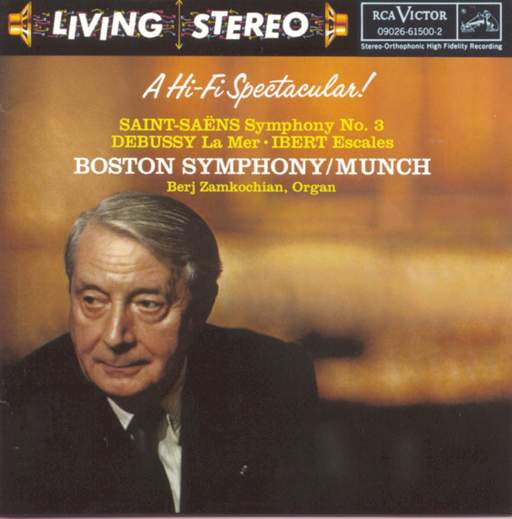
This is one of the great Living Stereo recordings, and the edition question here is less about finding something listenable than about deciding how close you want to get to the original tapes. None of the three editions fail the music. They do not all serve it equally.
Saint-Saëns completed his Third Symphony in 1886, at what he considered the peak of his powers, and dedicated it to the memory of Franz Liszt, who had died that summer. The shadow of that dedication is audible in the music: the opening theme is said to draw paralels with Dies irae, and there is something valedictory in the way the work moves from darkness toward the luminous major-key organ entry of the finale.
It was his last symphony. The 1959 recording by Charles Munch and the Boston Symphony Orchestra, made at Symphony Hall Boston over two April sessions and captured on three-track analog tape by engineer Lewis Layton, remains the benchmark.
Munch conducts with the authority of someone completely at home in this repertoire, and organist Berj Zamkochian's contribution to the finale is exactly what the music asks for.
What to listen for
- Room ambience
- Strings, placement, spacing, transients
- Organ tone
- Soundstage
Editions
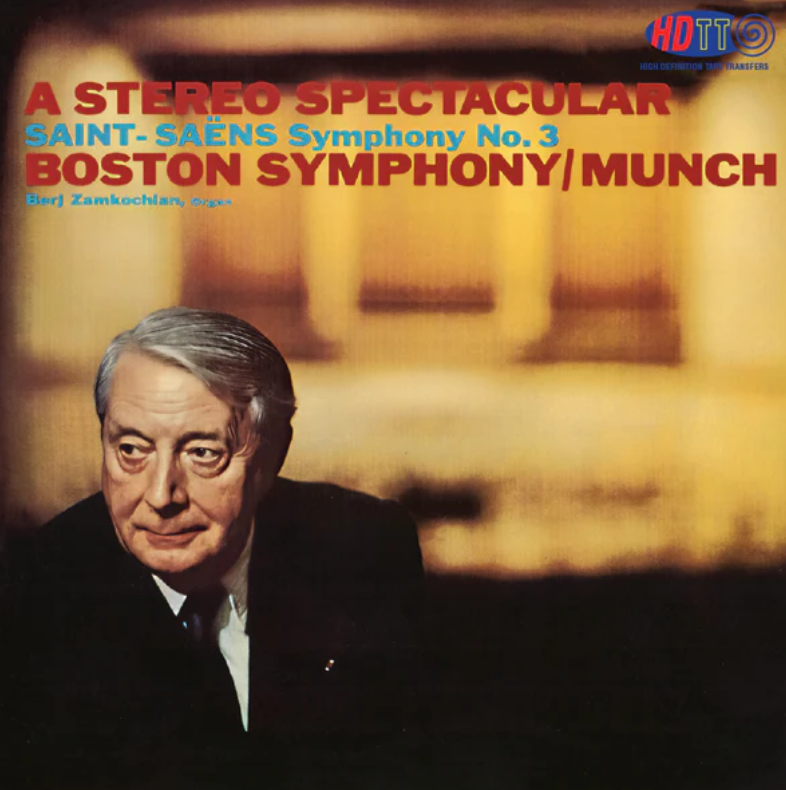
- Label:
- HDTT
- Year:
- 2022
- Format:
- Up to DSD256
- Source:
- Analog tape
The most naturally sounding edition. The natural tone, warm analog sound, impressively big soundstage, good separation, and lack of compression make it an ideal companion when you want to immerse yourself in the music. Because there is no significant compression or attempt to push the mids, transients may seem slower, but that contributes to the lovely, lush sound of the strings — hear the opening to Poco Adagio, for example. That said, there is still enough grit on the strings and detail for this not to sound like a murky vinyl.
The most natural sounding digital edition of this work. If you are looking to immerse yourself in Munch's reading of the Saint-Saëns Third, particularly on headphones, this is the one to go for.
- Label:
- RCA Red Seal
- Year:
- 15 March 2013
- Format:
- 24/176.4 FLAC
- Source:
- ?
At least two editions appear across streaming services and stores with different covers; they appear to share the same mastering.
A much louder and brighter edition compared to the HDTT. The compression is audible, the top mids have clearly been pushed up in mastering, and the soundstage is noticeably smaller. Transients seem a little faster, and the organ is brighter too, in ways that flatter at first but start to feel like a choice made for the edition rather than the music.
Not a bad edition, but if you're looking for purer, more dynamic sound, you may find the compression and EQ work against the recording's natural character
- Label:
- Living Stereo
- Year:
- 15 March 2013
- Format:
- 16/44 FLAC
- Source:
- ?
Expanded programme including Debussy's La Mer and Ibert's Escales.
Very similar in character to the RCA Red Seal hi-res edition, and the differences between the two are likely a reflection of format rather than a meaningfully different mastering. The compression here is a touch more noticeable and the top mids sit slightly higher, which gives it a brightness that sounds impressive on first listen. Loud and bright editions tend to do that. Once you settle in, though, the pushed sound becomes harder to ignore, and the soundstage feels smaller than a 1959 Living Stereo recording from Symphony Hall has any right to be.
Probably the least engaging of the three, though the gap between this and the RCA hi-res is narrow and may owe as much to the format as to the mastering. The compression is clearly noticeable and the edition lacks the depth and space this recording should have.
Closing notes
None of the three editions of this recording sound bad, and that is worth saying plainly before anything else. The two Sony editions, whether the RCA Red Seal hi-res or the Living Stereo lossless, are compressed and bright, with the high mids pushed up in mastering, but neither is unlistenable.
If you want a good-sounding version of Munch's reading and the RCA hi-res is the most convenient option, it will serve you well enough on most systems.
So, the choice really comes down to how you want to listen. For casual engagement, any of these editions will do. But if you want to sit with the lush strings, the natural room of Symphony Hall, and the full weight of what Layton captured on those three-track tapes in 1959, the HDTT transfer is the only edition that takes you there.